The 4 Types of AI Tools: Which Friend Are You Talking To?

Agilar Team
10 Aug, 2026
tool
tool
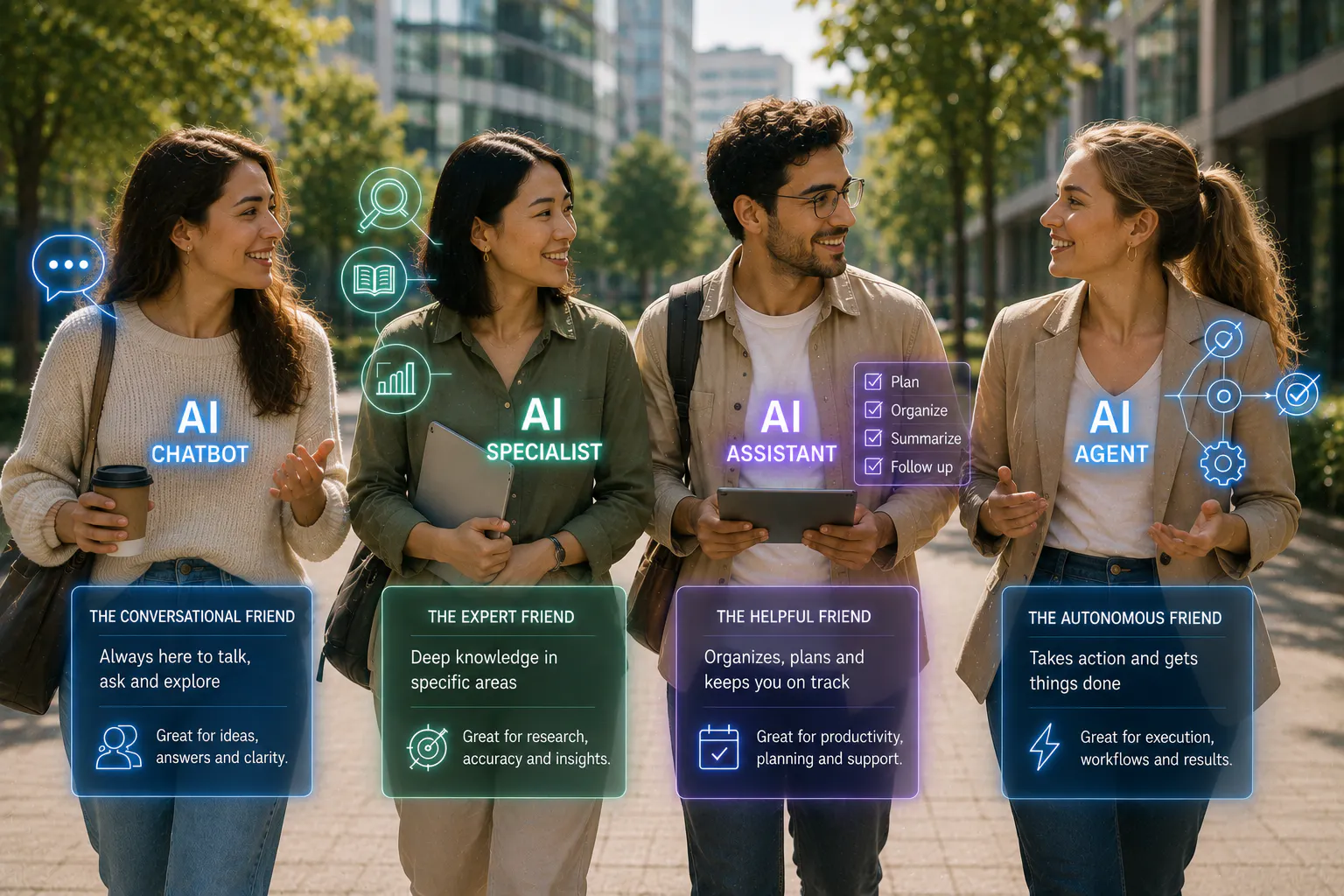
Think about your group of friends. There’s the one you call when you need to think out loud. You don’t expect them to solve the problem for you; sometimes you just need someone smart to bounce ideas off until things start making sense. Then there’s the friend you call for that one thing. They have a particular skill, you know they’re good at it, and you trust them to get the job done.
There’s also the friend who doesn’t just give advice. They roll up their sleeves and help, so you divide the work, stay involved and figure things out together. And finally, there’s the friend you trust enough to simply say, “Can you take care of this?”
Four friends, four very different relationships. AI works in a surprisingly similar way.
The landscape of AI tools can be divided into four broad categories: chatbots, specialists, assistants and agents. What separates them is how much human involvement they require and how much autonomy they have.
Understanding that difference matters because moving from one category to another isn’t simply about using “more advanced AI”. It changes the relationship between you and the AI. So perhaps the question isn’t just “Which AI tool should I use?” A better question might be: What kind of AI friend do I need for this work?
Chatbots: The friend you think out loud with
Chatbots are the easiest place to start. Tools such as ChatGPT, Gemini, Claude or Copilot can help you think and generate content, but out of the box they have very little autonomy. They can’t independently send an email, modify a file or change your calendar.
Think of them as the friend you call when you need to think out loud. You bring the problem and the context, the chatbot helps you explore it, and you evaluate what comes back. If the answer isn’t quite right, you challenge it, add information and keep the conversation going.
This relationship requires a lot of human involvement, but that isn’t necessarily a disadvantage. In fact, it’s where you develop the foundational skills you’ll need for every other type of AI: problem definition, prompt structuring, context setting, output evaluation and output iteration.
Once those skills are in place, however, the relationship can start to change.
Specialists: The friend you call for that one thing
You probably have someone in your circle who is the person for a particular job. With them, you don’t need a long conversation every time. You know what they’re good at, they know how to do it, and you give them what they need.
That’s an AI specialist.
The masterclass compares specialists to agency contractors: tools you call when you need a specific skill. Examples include Grammarly, custom GPTs, Gems and Skills. They follow a process you have defined, so once they’re trained, your involvement can drop significantly: you provide the input and they return the output.
The relationship has shifted. Instead of thinking through something together every time, you have taught AI a repeatable way of doing a particular kind of work.
But what happens when that one skill isn’t enough?
Assistants: The friend who helps you get things done
Then there’s the friend who hears about your problem and says, “Okay, what do we need to do?” They don’t just give you advice or perform one specialised job. They get involved and help you move the work forward.
AI assistants work in a similar way. They can be embedded in the applications you already use or custom-built to accompany you through a workflow. They have more autonomy than a chatbot, but you are still the senior person in the relationship: you trigger the work and review it as it happens.
At this point, knowing how to prompt well isn’t enough. You also need to understand the workflow, break work into tasks, manage the context AI needs at different points and control the quality of what comes back.
You’re no longer simply asking AI to do something. You’re figuring out how to work together.
Agents: The friend you trust to take care of it
And then there’s a different relationship entirely. Instead of saying “Can you help me do this?”, you say: “Can you take care of this?”
Agents are described in the masterclass as senior employees or whole teams. Rather than receiving individual tasks, they can be given responsibilities. They follow processes to deliver outcomes and can integrate with systems and tools to take real actions with much less human involvement.
That’s a significant leap, because once AI can act, the consequences of getting something wrong change too.
Think about asking a friend for advice about organising something at home. That’s one thing. Giving them the keys to your house and saying “Sort it out while I’m away” is something else.
There is a similar boundary in AI. The masterclass calls it the agent frontier. With a chatbot, AI can respond but can’t independently touch anything. Once you cross the frontier, AI begins interacting with your systems, tools and data. That unlocks new capabilities, but it also introduces risk.
So greater autonomy shouldn’t automatically be the goal. The real question is how much autonomy makes sense for the work you’re trying to do, and whether you have the skills and checks needed to manage it.
You don’t start by handing over the keys
There’s one more important thing about these four AI friends: they aren’t four completely separate relationships. Each one builds on the previous one.
The skills developed with chatbots become the foundation. Specialists add process definition, tool literacy, tuning parameters and diagnosing errors. Assistants add workflow thinking, task decomposition, context orchestration and quality control. Agents add another layer again: value stream mapping and system design, defining goals and constraints, integrating tools, risk management, monitoring and evaluation, and agent orchestration.
That’s why the most autonomous AI isn’t necessarily the best place to start. The goal isn’t to move from chatbot to agent as quickly as possible, but to understand what kind of relationship the work actually requires. Sometimes you need the friend you can think out loud with. Sometimes you need a specialist who already knows the process. Sometimes you need someone working alongside you. And sometimes you’re ready to hand over responsibility.
Start with the friend you can think with. Learn how to define problems, provide context, evaluate answers and iterate. From there, you can decide when you’re ready to teach AI a process, bring it into your workflow and eventually give it greater responsibility.
Because before asking “Which AI tool should I use?”, there may be a better question: “What role do I actually need AI to play?”
And once you know the answer, you need the skills to make that relationship work. If you want to develop those skills hands-on, join our Collaborating with AI Agents training and learn how to move from thinking with AI to building processes, designing AI-powered workflows and collaborating with agents.
Because before you hand AI the keys, it helps to know exactly who you’re giving them to.
Continue the series: AI Chatbots - The Friend You Think Out Loud With